
In this guide
- ABM platforms at a glance
- Enterprise suites: for thousands of accounts and a clean CRM
- Mid-market and ad-led platforms: account and contact-level advertising
- Light options: under a few hundred accounts or early data maturity
- Master comparison table
- How to pick by program size and data maturity
- Build it with AI: a light ABM stack
- What stopped being true
- FAQ
- The verdict
As of November 2026, two of the most-listed ABM platforms trade under new names. rollworks.com now redirects to AdRoll’s ABM product, and terminus.com redirects to DemandScience. Clearbit’s free visitor report was retired on 30 April 2025. A 2025 shortlist is already out of date.
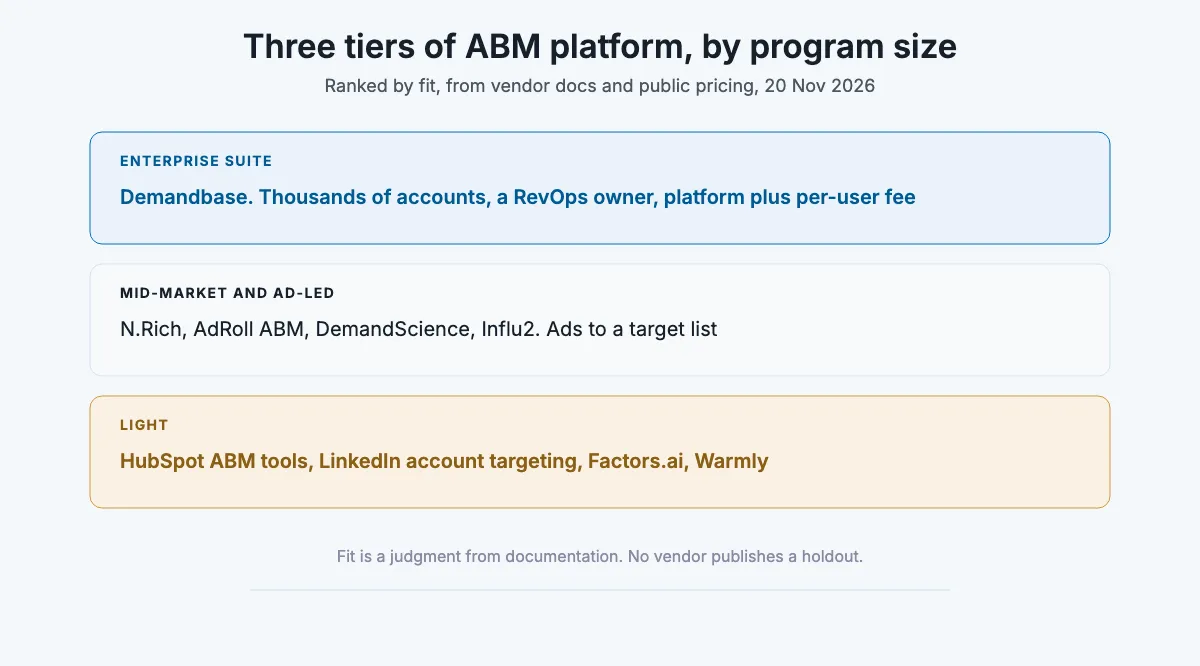
Here is the law that orders this list. The right ABM platform is the one that matches the program your team and data can run today. Account count and data maturity (a clean CRM, a written ICP, stage definitions sales agrees with) decide the tier first. Features decide the vendor second.
So the tools below are ranked by fit, not by quality. Enterprise suite first, then mid-market and ad-led platforms, then light options that cover the core job for a few hundred accounts. For how buying committees and pre-contact research shape the program itself, see how B2B buyers buy.
How we know
Sources: each vendor’s own product and pricing pages, read 20 November 2026, LinkedIn’s Marketing API documentation (versions dated August and November 2026), Claude’s Help Center, and the GTM cluster’s evidence on intent data, visitor identification and buyer surveys (LinkedIn and Ipsos’s 2025 survey of more than 900 buyers).
Period: April 2025 to November 2026.
First-party: one labeled line from one B2B account.
What the data cannot tell you: no vendor or independent study publishes a holdout showing which platform produces more pipeline, so fit here is a judgment from documentation, not a measured result.
ABM platforms at a glance
| Tier | Tool | Fits when |
|---|---|---|
| Enterprise suite | Demandbase | Thousands of accounts, several sales teams, a RevOps owner and a CRM in good shape |
| Mid-market, ad-led | N.Rich | You want intent-led display and video ads to a target list on a published annual price |
| Mid-market, ad-led | AdRoll ABM (formerly RollWorks) | You want account-based ads and alerts, with a media-only retargeting entry point |
| Mid-market, managed | DemandScience (Terminus) | You would rather buy programs run for you than operate software |
| Mid-market, contact-level | Influ2 | Your buying committees are known by name and you want ads to those people |
| Light | HubSpot ABM tools | You already run HubSpot Professional or Enterprise |
| Light | LinkedIn Campaign Manager account targeting | You have a few hundred named accounts and LinkedIn is your main paid channel |
| Light | Factors.ai | You need company-level visitor identification and LinkedIn influence on a small budget |
| Light | Warmly | You want visitor identification plus inbound chat and alerts in one tool |
How we picked
The ranking axis is fit to program size and data maturity, from enterprise to light. The comparison is based on each vendor’s own documentation and public pricing as of 20 November 2026. We did not test any platform hands-on. Two often-listed platforms are not scored: 6sense, because 6sense.com did not resolve from our tools on 20 November 2026, so nothing could be checked on its own site, and Madison Logic, whose site refused our fetch tool while we built the list (it loads in a browser and lists ABM display, connected TV, audio, LinkedIn and content syndication programs with no published prices, so check it directly). Vendor case studies, win-rate claims and review-site ratings were excluded because none publishes a controlled comparison.
Enterprise suites: for thousands of accounts and a clean CRM
An enterprise suite earns its cost only when you run account programs at a scale a person cannot read. That usually means thousands of named accounts, several regions or product lines, and an operator whose job is the platform. 6sense, the suite most lists pair with Demandbase, could not be verified on its own site on 20 November 2026, so check its current packaging directly before you shortlist it.
1. Demandbase
Demandbase sells a combined account-based platform for marketing and sales. Its site describes modules for marketing, advertising, sales intelligence and data, with Demandbase AI on top, aimed at marketing, sales, customer success and RevOps teams, including enterprise segments.
| Detail | Demandbase |
|---|---|
| Type | Enterprise account-based GTM platform |
| Fits when | Thousands of accounts, several teams, a dedicated operator |
| What it does | Account identification and prioritization, advertising to accounts, sales intelligence, unified account data |
| Pricing (vendor page, 20 Nov 2026) | Not published: a platform fee plus a per-user fee, quoted by form |
| Limitation (verified) | Sales and Marketing are sold together (“we don’t split Demandbase into separate solutions”), and cost scales with users |
| Skip if | You have one marketer, no RevOps owner, or fewer accounts than a person can review weekly |
Who it’s for: enterprise B2B teams where marketing and sales share one account program across many accounts. In practice: the per-user fee means the business case depends on how many sellers will work from it. Verdict: a suite to buy when the operator and the data are in place, not to buy so that they appear.
The strongest case for a suite: at thousands of accounts across regions, intent coverage, identification and orchestration in one system are hard to rebuild by hand. Below that scale, the per-user model works against you.
Quick Summary
Q: When does an enterprise ABM platform make sense?
A: When you run account programs across thousands of accounts with several sales teams, a clean CRM and a person whose job is the platform. Demandbase prices by platform fee plus users and sells sales and marketing together, per its pricing page on 20 November 2026.
Insight
In LinkedIn and Ipsos’s 2025 research with more than 900 B2B buyers, LinkedIn reports that buyers typically shortlist 2 to 3 vendors. That is the case for account programs in general. It is not evidence that any platform wins those shortlists.
LinkedIn Sales Solutions, The Trust Advantage, 2025
Mid-market and ad-led platforms: account and contact-level advertising
These platforms sell the advertising half of ABM without a full suite. If you have a target list of a few hundred to a few thousand accounts and an ads budget, they put ads in front of those accounts and report engagement by account. They differ on whether you run the software or they run the program.
2. N.Rich
N.Rich is the rare ABM platform that publishes its prices. It shows ads only to target accounts across article, video, cross-channel and image display formats, with intent topics per plan.
| Detail | N.Rich |
|---|---|
| Type | Intent-led ABM advertising platform |
| Fits when | A few hundred to a few thousand accounts, an ads budget, and a need to see published costs before a sales call |
| What it does | Intent topics, ads shown only to target accounts across display, video and native formats |
| Pricing (vendor page, 20 Nov 2026) | GTM Scale $35,520 a year ($2,960 a month billed annually), GTM Command $57,240 a year, Enterprise custom, VAT excluded |
| Limitation (verified) | Annual license only, ad spend billed separately with a 12-month baseline commitment, AI credits one-time with no rollover |
| Skip if | You cannot commit to a year of ad spend on top of the license |
Who it’s for: mid-market B2B teams that want account-level ads and intent on a known budget. In practice: the license is only part of the cost, so model the media commitment before you compare it with a suite. Verdict: a transparent mid-market option if a year-long media commitment suits your plan.
3. AdRoll ABM (formerly RollWorks)
AdRoll ABM is what RollWorks became. rollworks.com now redirects to AdRoll’s ABM page, which describes multi-channel ads to target accounts, buying-signal alerts, integrations and account reporting through to closed-won.
| Detail | AdRoll ABM |
|---|---|
| Type | Account-based advertising and orchestration |
| Fits when | You want account ads plus alerts, and to start small with retargeting |
| What it does | Multi-channel ads to target accounts, buying-signal alerts, CRM and data integrations, pipeline reporting |
| Pricing (vendor page, 20 Nov 2026) | ABM plans by demo, no prices shown. Account-Based Retargeting: “No fee to get started and pay only for media” |
| Limitation (verified) | No published ABM prices: every ABM package on the pricing page is demo-only. The one-year Advanced Package there is a general AdRoll package, not an ABM one |
| Skip if | You need a published price before talking to sales, beyond the retargeting tier |
Who it’s for: B2B marketers who want account advertising with a low-commitment way in. In practice: the retargeting tier lets you test account ads on media spend alone before a platform conversation. Verdict: the easiest mid-market entry point to test, then decide whether you need the full ABM plan.
4. DemandScience (formerly Terminus)
terminus.com now redirects to DemandScience, which sells ABM as programs it runs. Its site lists a data and AI layer, a managed campaigns team, website intelligence, audience data, media placement and content syndication.
| Detail | DemandScience |
|---|---|
| Type | Managed ABM programs plus data |
| Fits when | You want account programs run for you rather than software to operate |
| What it does | Audience data, website intelligence, managed multi-channel campaigns, content syndication |
| Pricing (vendor page, 20 Nov 2026) | No prices published. The site says there are no platform licenses and no software to buy |
| Limitation (verified) | A managed model: DemandScience runs the programs, so your team has less direct control, and the home page no longer mentions Terminus |
| Skip if | You want to own the targeting and the data in your own tools |
Who it’s for: teams without an ABM operator that would rather buy outcomes-oriented programs. In practice: if you were a Terminus customer, check what your contract now includes, since the brand you bought is no longer on the vendor’s site. Verdict: consider it when headcount, not software, is your constraint.
5. Influ2
Influ2 targets people, not accounts. Its site describes contact-level intent, ads served to selected contacts with reach reported by name, buyer journeys by stage, and revenue reporting through a CRM integration.
| Detail | Influ2 |
|---|---|
| Type | Contact-level ABM advertising |
| Fits when | You know the buying committee by name and want ads to those people |
| What it does | Contact-level intent, ads to named contacts, journeys by stage, CRM revenue reporting |
| Pricing (vendor page, 20 Nov 2026) | Not published, demo only |
| Limitation (verified) | The home page names no specific ad networks, so channel coverage has to be confirmed in a sales call |
| Skip if | Your account lists are not yet mapped to named people |
Who it’s for: teams with small, high-value account lists and named committees, where sales wants to know who saw what. In practice: contact-level programs depend on a contact list you keep current, so budget the list work, not only the license. Verdict: a strong fit for named-committee selling once the contact data exists.
Quick Summary
Q: Which ABM platforms suit a mid-market B2B team?
A: Ad-led platforms that put ads in front of a target list: N.Rich publishes annual prices from $35,520 plus separate media, AdRoll ABM offers a media-only retargeting entry point, DemandScience runs managed programs, and Influ2 targets named contacts. All were checked on their own sites on 20 November 2026.
Insight
The intent many of these platforms sell is relative reading volume. Bombora’s own documentation scores each account and topic on its last three weeks against a 12-week baseline. A surge says an account is reading more than usual, not that it is buying.
Bombora, Intent methodology (GTM cluster evidence, checked October 2026)
Light options: under a few hundred accounts or early data maturity
Below a few hundred named accounts, a CRM view, LinkedIn’s own account targeting and one point tool cover the core job. That line is a rule of thumb, not a measured threshold: at that size one person can read every account’s signals each week, and suite pricing charges for scale you do not use.
6. HubSpot ABM tools
If you already run HubSpot, its ABM tools may be enough. HubSpot says its “ABM software is available in Marketing Hub and Sales Hub”, in “the premium versions”, with a target accounts view, key-account dashboards and workflows.
| Detail | HubSpot ABM tools |
|---|---|
| Type | CRM-native ABM features |
| Fits when | You already use HubSpot Marketing Hub or Sales Hub at a premium tier |
| What it does | Target account views, key-account dashboards, workflows for account updates and follow-ups |
| Pricing (vendor page, 20 Nov 2026) | Marketing Hub Professional listed at $800 a month and $890 a month with 3 core seats and a required $3,000 onboarding fee, Enterprise $3,600 a month with 5 seats and $7,000 onboarding (USD) |
| Limitation (verified) | ABM tools sit only in premium editions, and HubSpot’s pricing comparison does not itemize them, so confirm the tier in a demo |
| Skip if | You run Salesforce without HubSpot, or a starter edition |
Who it’s for: HubSpot customers with a few hundred target accounts and no separate ABM budget. In practice: the account view is only as good as your company records, so de-duplicate and tier accounts first. Verdict: the cheapest serious option if you already pay for a premium HubSpot edition.
7. LinkedIn Campaign Manager account targeting
LinkedIn’s own account targeting is the ABM layer many small programs already own. LinkedIn’s documentation describes uploading a CSV list of companies to match to LinkedIn company pages, Predictive Audiences built from a company or contact list, and ad reporting that can be pivoted by company.
| Detail | LinkedIn Campaign Manager |
|---|---|
| Type | Ad platform account targeting and company-level reporting |
| Fits when | A few hundred named accounts and LinkedIn as the main paid channel |
| What it does | Company list upload for targeting, Predictive Audiences, company-level ad analytics |
| Pricing (LinkedIn docs, 20 Nov 2026) | No separate ABM license is described in LinkedIn’s documentation. You pay for the ads |
| Limitation (verified) | Initial matching can take up to 48 hours, segments are archived after 30 days unused and expire after 90, and company-level reporting is approximate, with values under 3 events dropped |
| Skip if | Your buyers are not active on LinkedIn, or you need non-LinkedIn channels |
Who it’s for: small B2B teams whose ABM is mostly LinkedIn ads to a named list. In practice: the Reporting API documentation notes that company reports can include companies you did not target, for example through job changes or audience expansion, so filter results to your list before reading them. Verdict: start here if you have under a few hundred accounts and no ABM budget.
8. Factors.ai
Factors.ai combines company-level visitor identification, LinkedIn influence and account scoring at published prices. Its pricing page lists company identification, LinkedIn Ads influence on accounts, account scoring, G2 impact tracking and ABM analytics across tiers.
| Detail | Factors.ai |
|---|---|
| Type | Account identification and ABM analytics |
| Fits when | You want to see which target accounts visit and engage, on a small budget |
| What it does | Identifies visiting companies, shows LinkedIn Ads influence, scores accounts, syncs to the CRM |
| Pricing (vendor page, 20 Nov 2026) | Lite $199 a month after a free trial, Basic $6,000 a year, Growth $20,000 a year, Enterprise from $36,000 a year |
| Limitation (verified) | Identified companies are capped per tier (1,500, 3,000 and 8,000 a month), and intent and LinkedIn features are split across tiers |
| Skip if | Your site traffic is too low to identify meaningful account activity |
Who it’s for: small and mid-market B2B teams that want account signals without a suite. In practice: check which tier includes the LinkedIn and intent features you need before you budget for Lite. Verdict: a sensible first paid tool once LinkedIn targeting and a CRM view are in place.
9. Warmly
Warmly bundles website de-anonymization with inbound chat and AI agents. Its pricing page lists contact and company identification, ICP filtering, alerts, routing and CRM sync, with chat and AI agents on higher plans.
| Detail | Warmly |
|---|---|
| Type | Visitor identification plus inbound chat |
| Fits when | You want identified visitors routed to sales with live or AI chat |
| What it does | Identifies visiting contacts and companies, filters by ICP, alerts and routes, syncs to the CRM |
| Pricing (vendor page, 20 Nov 2026) | AI Web-Deanonymization listed at $10,000 a year or $4,875 a quarter (the page does not say which billing option each figure belongs to), Inbound Chat from $20,000 a year, AI Inbound Autopilot from $30,000 a year, GTM Signals add-on $10,000 a year |
| Limitation (verified) | Credit-based (“From 10K credits / mo”), intent data is a paid add-on, and the pricing page does not say where person-level identification works |
| Skip if | Most of your traffic is from the EU or UK and you have no consent setup |
Who it’s for: teams with steady inbound traffic that want sales to act on identified visitors fast. In practice: in one B2B account I ran in 2026, a person-level identification tool produced many identifications and no useful leads, so treat names as a prioritization signal, not a lead list. Verdict: worth it if you have the traffic and a sales team ready to respond, not as a lead source by itself.
The condition for every identification tool on this list: if you have EU or UK visitors, EU regulators’ guidance brings tracking scripts and pixels under the same consent rules as cookies, and at least one major vendor in this category says it “does not enforce consent compliance on your behalf”. Get legal review before turning on person-level identification outside the US.
Quick Summary
Q: Do I need an ABM platform for under 500 target accounts?
A: Usually not an enterprise suite. HubSpot’s premium editions, LinkedIn’s own account targeting and one point tool such as Factors.ai (from $199 a month) or Warmly (from $10,000 a year) cover the core job, and a person can read every account’s signals weekly at that size. This is a rule of thumb, not a measured threshold.
Insight
LinkedIn’s own documentation warns that company-level reports “can include companies that were not targeted in a campaign” because people change jobs or work at several companies. Treat account engagement as a hint to check, not a fact.
LinkedIn Marketing API, Reporting (Microsoft Learn, updated 11 Nov 2026)
Master comparison table
| Tool | Tier | Fits when | Pricing model (20 Nov 2026) | The watch-out | Skip if |
|---|---|---|---|---|---|
| Demandbase | Enterprise | Thousands of accounts, RevOps owner | Platform fee plus per-user fee, on request | Sales and Marketing bundled | One marketer, small list |
| N.Rich | Mid-market | Intent-led ads on a published price | From $35,520 a year plus media | 12-month media commitment | No year-long ad budget |
| AdRoll ABM | Mid-market | Account ads with a small start | ABM by demo, retargeting media-only | ABM packages demo-only | You need published ABM prices |
| DemandScience | Mid-market, managed | Programs run for you | On request, no platform license | Less in-house control | You want to own the data |
| Influ2 | Mid-market, contact-level | Named committees | On request | Channels not named on site | No named contact list |
| HubSpot ABM tools | Light | Existing premium HubSpot | Pro from $800 a month plus $3,000 onboarding | Premium editions only | Not on HubSpot |
| LinkedIn account targeting | Light | LinkedIn-led, a few hundred accounts | Ad spend only | Approximate company reporting | Buyers not on LinkedIn |
| Factors.ai | Light | Account signals on a small budget | From $199 a month | Identified-company caps | Low site traffic |
| Warmly | Light | Identified visitors plus chat | From $10,000 a year | Credits, intent extra | EU or UK traffic without consent |
How to pick by program size and data maturity
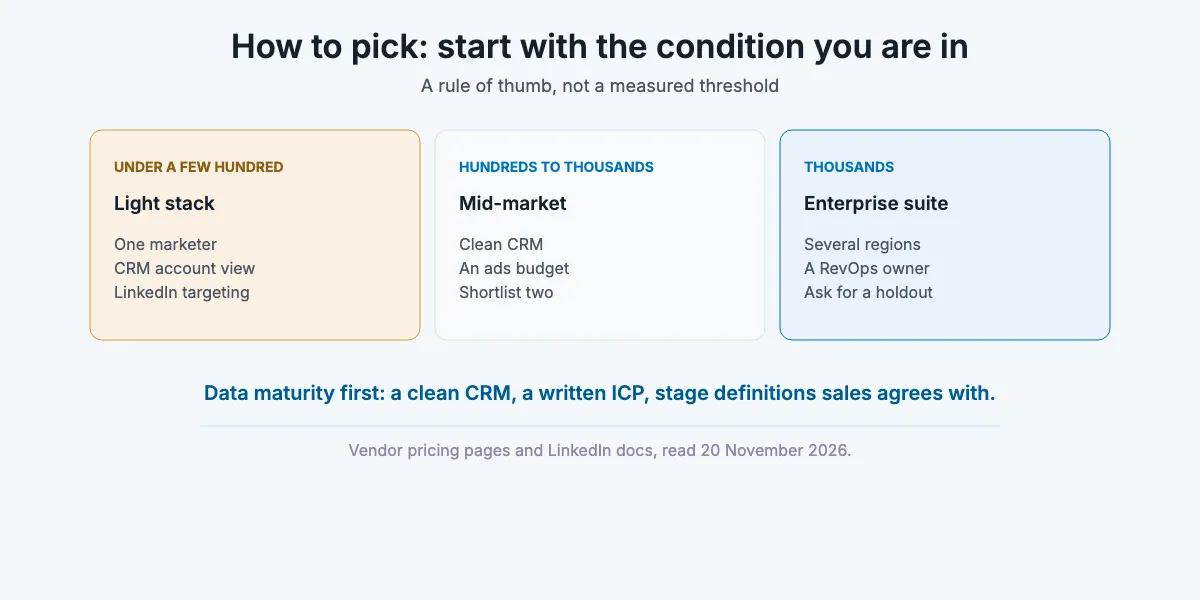
Start with the condition you are in, not the feature list.
- If you have under a few hundred named accounts and one marketer, use your CRM’s account view (HubSpot’s premium tier if you have it), LinkedIn’s account targeting and, if budget allows, one signal tool. Build the weekly brief below before buying anything else.
- If you have a few hundred to a few thousand accounts, a clean CRM and an ads budget, shortlist two mid-market platforms. Pick N.Rich or AdRoll ABM if you want to run it yourself, DemandScience if you would rather buy managed programs, and Influ2 if your committees are named.
- If you have thousands of accounts, several regions and a RevOps owner, evaluate an enterprise suite, and ask each vendor for a holdout design you can run in your own account before signing a multi-year contract.
What would change the call: a vendor publishing a controlled comparison of pipeline with and without its platform, or LinkedIn opening richer company engagement data in its standard reporting. Until then, budget and data maturity decide.
Match the tier to the team. Then pick the vendor.
Build it with AI
Build it with AI: a light ABM stack
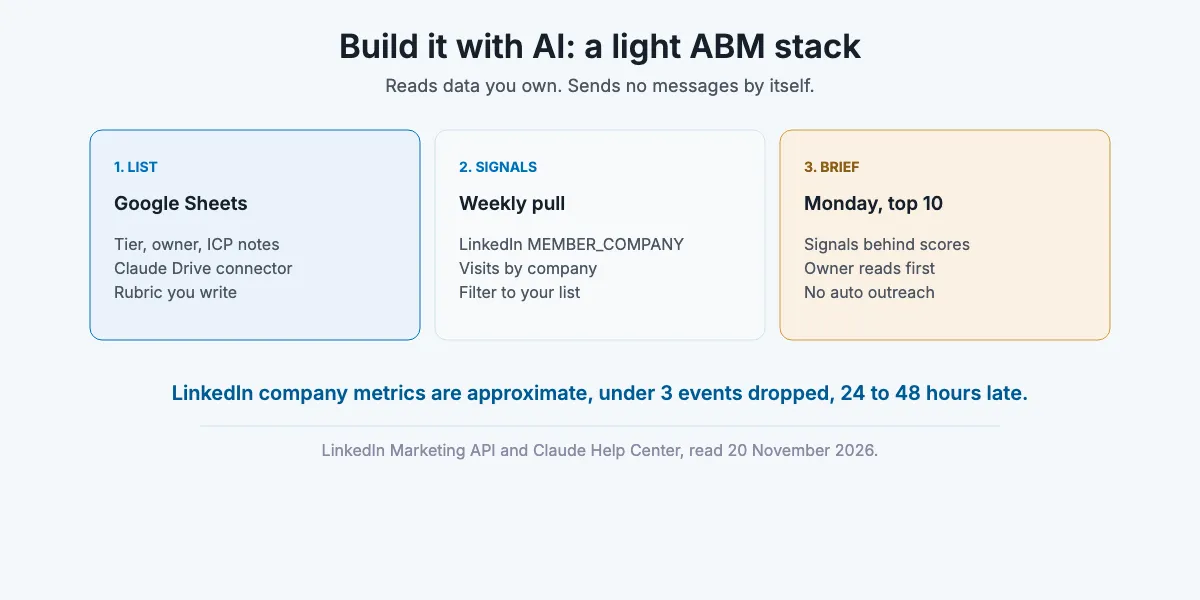
This build covers the core of ABM for a few hundred accounts: a tiered list, weekly account signals and a brief a person acts on. It reads data you already own and sends no messages by itself.
1. Keep the target list in Google Sheets. One row per account: company, domain, LinkedIn company page, tier, owner, ICP notes, last contact. Claude’s Google Drive connector can read Sheets, and on Team and Enterprise plans an Owner enables it first. Claude sees only what the connected Google account can see. The connector can also create and edit files, so ask it only to read for this job.
2. Pull LinkedIn engagement by company every Monday. A small script calls LinkedIn’s Reporting API (adAnalytics with pivot=MEMBER_COMPANY, permission r_ads_reporting) for the last seven days and writes impressions, clicks and landing-page clicks per company to a second tab. LinkedIn says these company metrics are approximate, drops values under 3 events, delays them 24 to 48 hours, and can include companies you did not target, so the script keeps only rows that match your list. Do not use automation tools that send invitations or messages, which LinkedIn’s User Agreement prohibits.
3. Add website visits by company. Export company-level visits from your CRM or the identification tool you already run (Factors.ai and Warmly both sync to CRMs) into a third tab. If you have EU or UK traffic, use company-level data only, with consent in place.
4. Have Claude score and brief, from a rubric you write. The scoring weights are yours, written in the sheet, not invented by the model. A prompt that works:
You are preparing a weekly account brief for a B2B marketing lead.
Inputs: the Targets tab (account, tier, owner, ICP notes), the LinkedIn tab
(company, impressions, clicks, landing page clicks, last 7 days), the Visits tab
(company, pages viewed, visit count) and the Rubric tab (weights for each signal).
1. Score each target account with the Rubric weights only. Show the inputs used.
2. List the 10 highest-scoring accounts with the specific signals behind each score.
3. For each, draft two lines: what the account looked at, and one suggested next step
   for the owner (a relevant piece of content, a call, or wait).
4. Flag accounts whose scores rose or fell sharply against last week.
Do not invent data, people or reasons. If a signal is missing, say it is missing.
5. Push changes back by hand, at first. When a tier changes, update the LinkedIn company list yourself. LinkedIn’s Matched Audiences API can update company segments automatically, but it needs separate API approval, and the first match can take up to 48 hours.
6. Optional CRM link, read-only. If you run HubSpot, its MCP server can read company and deal records so the brief shows open deals next to each account. Keep it read-only for this job.
7. Schedule and checkpoint. The script and the brief run every Monday. The account owner reads the brief before any outreach, and no message goes out because a score changed. Review the rubric once a quarter against which accounts became opportunities.
What this replaces, and what it does not: it replaces the dashboard and the weekly prioritization a light-tier tool sells. It does not replace third-party intent coverage or identification at enterprise scale.
Quick Summary
Q: Can I build a light ABM stack with AI?
A: Yes for a few hundred accounts: a target list in Google Sheets, LinkedIn’s Reporting API for company-level ad engagement, company-level site visits from your CRM, and a weekly Claude brief scored on a rubric you write. A person reads the brief before any outreach.
Insight
LinkedIn’s Matched Audiences documentation spells out the cost of automating the list sync: access to the Advertising API “doesn’t automatically grant access to DMP Segment APIs”, and developers “must apply separately”. Start manual, then automate the parts that repeat.
LinkedIn Marketing API, Matched Audiences (Microsoft Learn, updated 17 Aug 2026)
What stopped being true
| What people still repeat | What changed | When | Primary source |
|---|---|---|---|
| RollWorks is a standalone ABM vendor | rollworks.com redirects to AdRoll ABM, “formerly RollWorks” | Checked 20 Nov 2026 | AdRoll’s ABM page and the rollworks.com redirect |
| Terminus is a standalone ABM platform | terminus.com redirects to DemandScience | Checked 20 Nov 2026 | terminus.com redirect, DemandScience site |
| Install the free Clearbit visitor report to see which companies visit | Clearbit’s free tools, including the Weekly Visitor Report, were retired | 30 Apr 2025 | Clearbit changelog |
| Intent data shows which accounts are in market | Surges are relative reading volume against an account’s own baseline | Methodology current Oct 2026 | Bombora intent documentation |
FAQ
What is an ABM platform?
An ABM platform is software for running marketing and sales programs aimed at a named list of accounts: identifying them, prioritizing them by signals, advertising to them and reporting engagement by account rather than by lead. Suites bundle all of it, and lighter tools cover one or two parts.
Do I need an ABM platform for under 500 target accounts?
Usually not an enterprise suite. At that size a CRM’s account view, LinkedIn’s account targeting and one signal tool cover the core job, and a person can review every account weekly. Treat 500 as a rule of thumb, since no published study sets a threshold.
How much does an ABM platform cost?
Published prices on 20 November 2026 ranged from $199 a month (Factors.ai Lite) to $57,240 a year (N.Rich GTM Command), plus media where ads are involved. Enterprise suites such as Demandbase do not publish prices and charge a platform fee plus a per-user fee.
Is intent data worth paying for?
Only as a prioritization hint you check against your own closed-won accounts. Third-party surges measure an account reading more than usual, which can be one analyst and one report. Your own site, product and review-site signals are narrower but harder to fake.
Can I connect AI agents to my ABM platform?
Yes through each platform’s API or connector where one exists, and the build above shows how far official routes go: Claude can read Sheets through its Drive connector, LinkedIn exposes company-level ad reporting through its API, and HubSpot’s MCP server reads CRM records. Start read-only and keep a person between the agent and any outreach.
What happened to RollWorks and Terminus?
On 20 November 2026, rollworks.com redirected to AdRoll’s ABM product, which describes itself as formerly RollWorks, and terminus.com redirected to DemandScience. If you hold a contract under the old name, ask what it now includes.
The verdict
Under a few hundred accounts and one marketer, build the light stack. With a few hundred to a few thousand accounts and clean data, shortlist two mid-market platforms. With thousands of accounts and a RevOps owner, evaluate a suite and insist on a holdout. The platform should match the program you can run, and the call changes only when a vendor publishes a controlled result or LinkedIn opens richer company data.
If you would rather have someone size your program and pick the tier with you, that is what I do in a consultation.
About this article

Written by
Sai Subramaniam
SEO, GEO and Paid Ads Manager · 8+ years in growth marketing
I have run SEO, paid media and ABM for B2B AI companies, consumer apps and live-entertainment brands, from a solo operator at an AI infrastructure company to a team of 20 recovering a million-visitor site after a Google update. I write these guides from that work, and every number in them carries its source.
Connect on LinkedInHow this one was checked. Every number traces to a named source with its dataset and period, and every platform feature, policy or limit cites the platform's own documentation with the date it was verified. Where the author's own results appear, they are labeled as one account's results, with the budget and context, not as a rule.
No affiliate links and no paid placements. Tools are named because they are what practitioners use, not because anyone paid to appear here.
Reviewed: November 2026. Ad platforms and search features change every few months. Anything we could not verify at the time of writing is marked as unverified rather than turned into a number.
Corrections. If something here is wrong or has changed since, we would rather know. Corrections are made in place, with a note saying what changed.
Want this wired into your own account?
One call to size the problem and agree the first three moves.